Documentary evidence of sending and receiving
Electronic notification
Pay per use. No registration fees. No expiration date.
As simple as sending an email.
Sign documents and contracts
Our locations We are global
Lleida
Madrid
Paris
London
Miami
Dubai
San José
Bogotá
São Paulo
Tokyo
Santo Domingo
Cape Town
Johannesburg
Montevideo
Santiago de Chile
Lima
Beirut
Ciudad de México

Our customers trust us
Case studies
We particularly loved the ease and agility of contracting the system and its credit-based use. In other words, you top up some credits and start working without too much training, without any specific software installation or technical complexity
Registered notification service has made possible to help in the internal operating processes of companies and in their digital transformation.
Lleida.net gives us peace of mind and guarantees that parents verify the engagement of our services in a simple safely and legally way.
Connectaclik Pro has provided Holaluz with effective and customized solutions,a must have for any services we will add to our processes.
“Thanks to this agreement we would provide security, reliability and efficiency to our users. Being a technological platform it is crucial to offer the highest quality and the greatest attention to our customers”











News, interviews, tutorials
Blog
 6 November, 2026
Sharing an El Gordo Ticket in Spain? Here's How to Protect Your Share
One ticket, a dozen people, a promise that “if we win, we’re all getting a villa in Mallorca” and not a single signature. Every December, that's how the Spanish Christmas Lottery begins for many people, and if you live in Spain or are visiting over the holidays, you may well be invited to join in. The prize everyone is hoping for is El Gordo ("the fat one"), the top prize of the draw.
Sharing an El Gordo ticket is as much a Spanish Christmas tradition as eating twelve grapes at midnight on New Year's Eve. Tickets are passed around at family dinners, among friends and at the office Christmas party, and hardly anyone stops to think about what would happen if, for once, the numbers came up. That's when the awkward questions start: who's holding the ticket? And how do you actually collect a shared prize?
The draw is on 22 December, so there's still time to get it right. Here's how to share your El Gordo ticket safely. The odds are slim, and the taxman takes a hefty cut, but if luck does go your way, the only decision left should be which island to anchor the yacht off.
[Table of contents block]
Why a shared lottery ticket needs proof
In Spain, a lottery ticket is a bearer document: the prize goes to whoever hands it in. Usually, it doesn't win, and nothing happens (the odds of winning El Gordo with a single ticket are 1 in 100,000). But if it does, things can get messy fast: who was in, who paid what, who joined at the last minute, and who's actually got the ticket.
Without proof dated before the draw, it could end up in court.
The good news? Avoiding all that is easy.
How to share an El Gordo ticket in five steps
Protecting your share is a lot easier than winning El Gordo. All it takes is your phone, five minutes and these five steps:
- Photograph the décimo. That's what the ticket is called in Spain. Make sure the number, series and fraction are clearly visible.
- Write down who's in. Note each person's name, how much they've put in, and what percentage of the ticket is theirs.
- Send a registered email to the whole group. Think of it as recorded delivery for email, sent from your usual email account. Attach the photo, outline the split in the message, and include the date of the draw. Add your name and ID number (your NIE or passport number if you don't have a Spanish DNI).
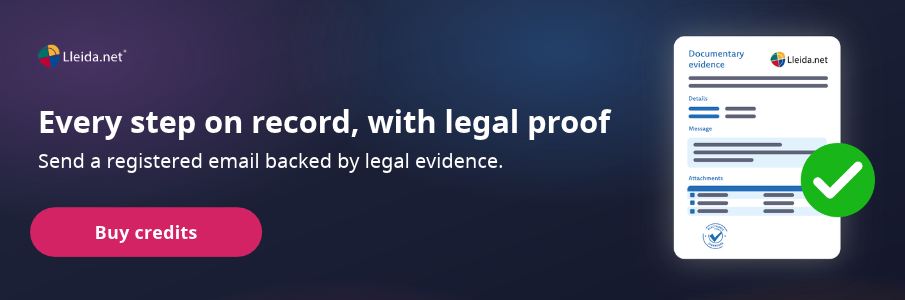
- Keep the documentary evidence. Lleida.net sends you a PDF proving who sent the message, to whom, what it said, what was attached, and the exact date and time. Consider it an insurance policy for your ticket.
- Keep the original somewhere safe. Hold on to it until the draw and, if you win, until the prize has been paid out.
Your colleagues and friends don't need to install anything or do anything at all: the email lands in their inbox like any other, with a note saying it's registered.
Is a WhatsApp photo enough?
According to Spain's consumer association OCU (Organización de Consumidores y Usuarios), a photo of the ticket sent on WhatsApp can count as proof, provided it shows who's holding the ticket, who's taking part and how much each person has. The catch: if someone challenges it and claims the image has been altered, you'd have to prove it hasn't, and that's not easy.
A Registered email to everyone involved, with the photo of the ticket and the list of contributions, heads off the problem before it starts. And it protects both the organiser and everyone else in the group.

Participaciones vs a shared ticket: what's the difference?
They're not the same thing, and it pays to know the difference.
Participaciones are slips issued by associations, clubs, peñas (social clubs) or companies, based on tickets they've bought. Each slip shows the number, the amount played and who holds the tickets: that person or organisation is responsible for paying out.
A shared ticket, by contrast, is an informal deal between individuals. There's no slip, and the only proof is whatever the organiser chooses to create. That's why putting it in writing, in a form that stands up as documentary evidence, matters even more.
Get your shared El Gordo ticket in writing before 22 December
Sharing El Gordo tickets is part of Christmas in Spain. Recording who's in takes five minutes and costs very little. Get it sorted now and, if your number comes up on 22 December, the only argument left will be who gets to choose the island.
¡Mucha suerte! Good luck!


 6 November, 2026
RCS Electronic Signature: Easy, Secure Signing on Mobile
Electronic signature continues to evolve towards contracting that is quicker, more accessible and more secure. Click & Sign and Openum now support RCS electronic signature, a channel that delivers signature requests and registered notifications directly to the recipient's messaging app from a verified sender and is backed by each service's legal guarantees.
RCS comes to electronic signature
RCS (Rich Communication Services) gives business messaging a more visual, interactive format: a verified sender (validated through a Google-backed process), brand identity and custom buttons. Messages are sent over Wi-Fi or mobile data at no extra cost and, on compatible devices, land in the phone's usual SMS inbox, so there's no additional messaging app to install.
Bringing RCS to Click & Sign and Openum meets a specific need: making communications more trustworthy by verifying who sends them. Recipients also get messages directly in their phone's messaging app, a more direct experience that fits how they handle their paperwork online. RCS messages in Click & Sign and Openum can be sent as standard or registered.
RCS electronic signature is a further sign of Lleida.net's commitment to continually evolving its services and improving the customer experience.
Want to know more about the technology? Find out what RCS is and how it works
How RCS electronic signature works with Click & Sign
Click & Sign is Lleida.net's platform for managing electronic signature processes, whether simple, advanced or qualified. With RCS electronic signature, businesses gain a new channel for getting signature requests to recipients, alongside SMS, email and WhatsApp.
Here's how RCS electronic signature works on a mobile phone:
- Send the document. The company starts the signature process in Click & Sign and picks RCS as the channel. This can be done manually on the platform or automatically via the API.
- The signer receives an RCS message. The request arrives as an RCS message showing the sender's verified brand identity.
- Open the document. The recipient taps the button or link in the message to open and review the document.
- Sign. The signer completes the process using the configured signature method, in accordance with the selected identification and authentication requirements.
- Get the signed copy. Once finished, the signer can access the signed documents and download the documentary evidence
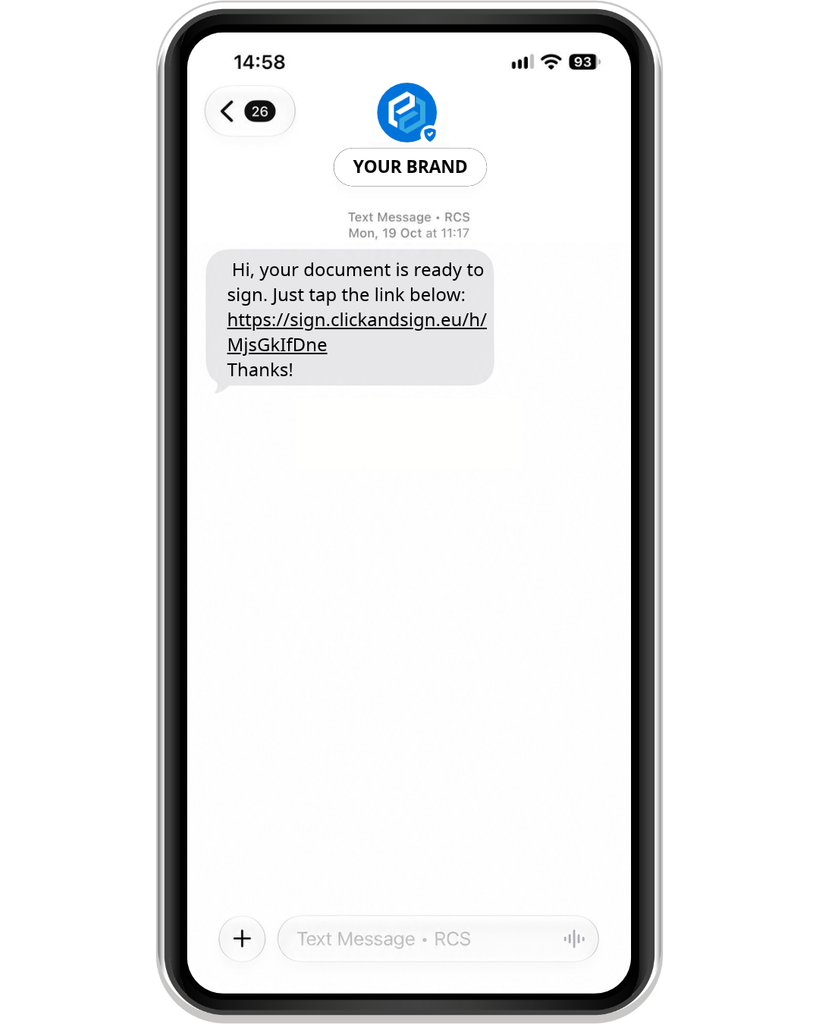
RCS electronic signature makes it possible to sign any contract or agreement online on a phone, with no paper changing hands, making remote contracting easier to manage.
Click & Sign can also be configured with different signature methods, ranging from simple to advanced, including qualified electronic signatures. Which one to use depends on the process's needs, the required level of security, and the configuration in place.
Is an RCS electronic signature an advanced electronic signature?
Whether an electronic signature is legally valid doesn't depend solely on the channel used to send the request. It also depends on how the signer is identified, how the signature is linked to the signed document and the safeguards the process provides.
Regulation (EU) No 910/2014, better known as eIDAS and amended by Regulation (EU) 2024/1183, sets out the requirements for an advanced electronic signature in Article 26. To be considered advanced, a signature must meet four conditions.
Uniquely linked to the signer
The signature request is sent to the recipient's phone number, linking the request to that specific signature process. That said, receiving a link on a phone doesn't, on its own, prove who is signing, so the additional safeguards in the process also need to be considered.
Capable of identifying the signer
The signature process can include identification data and verification mechanisms to establish who signs the document. The level of assurance depends on the identification and authentication methods used in each case.
Created using data under the signer's sole control
The signer completes the process on their own mobile device. To meet this requirement, however, the procedure must provide sufficient assurance that the signature creation data are under the signer's sole control; using a personal device alone is not enough.
Able to detect any subsequent changes
The signed document includes sealing mechanisms and electronic evidence to verify its integrity and detect any subsequent modifications. This evidence also records how the signature process was carried out.
What does this mean for RCS electronic signature?
RCS is the communication channel used to deliver the signature request to the recipient. How the signature is classified in legal terms depends on the mechanisms used during the process and on whether the applicable requirements are met.
In other words, an RCS electronic signature via Click & Sign can be part of an advanced electronic signature process, provided the configuration used meets the conditions set out in Article 26 of eIDAS.
Registered notifications by RCS with Openum
RCS electronic signature is just the start: the channel also opens up new options for sending certified business communications through Openum.
Openum certifies access to the content of the electronic communications you send. With RCS, the notice reaches the recipient through a certified channel that combines a verified brand identity with a more visual presentation.
This is particularly useful for organisations that need to share important information and keep electronic evidence of the process. Use cases for certified RCS with Openum include:
- Legal requests and communications, making it easier for recipients to access important information.
- Contractual communications, ensuring notices about contracts, agreements or service terms are delivered.
- Customer notices, to keep customers informed about procedures, formalities or the services they have signed up for.
Why sign by RCS rather than SMS?
RCS electronic signature opens up new ways to present and deliver a signature request. The idea isn't necessarily to replace SMS, but to have another channel that suits each process and each recipient.
Benefits of RCS electronic signature:
- Verified sender and brand identity. Messages display the company's name and visual identity, which are verified beforehand through a Google-backed process. Recipients can easily recognise who is contacting them, which builds trust and helps reduce the risk of impersonation, smishing and phishing, keeping message security high. It also helps improve open rates.
- Sent over Wi-Fi or mobile data, with no extra connection costs. RCS messages travel over the device's internet connection, either Wi-Fi or mobile data, at no additional cost.
- Accessible from the phone's usual messaging app. Messages land in the native messaging inbox of compatible devices, right where users already get their SMS, with no extra apps to install.
RCS and SMS can complement each other within a company's communications. Which channel is available depends on device compatibility, service coverage, and how sending is configured.
To learn more about each technology, see the differences between RCS and SMS
Use cases by sector: where can RCS electronic signature be used?
RCS electronic signature can be useful in a range of sectors where speeding up contracting and making documents easy to access matters.
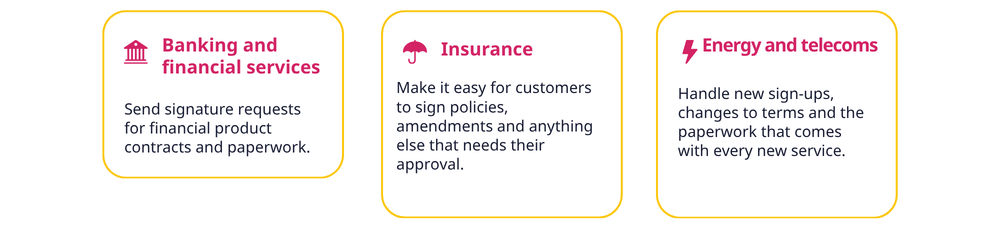

With RCS now in Click & Sign and Openum, digital communications can do more. Businesses can bring signature requests and notifications closer to their customers through a visual, interactive channel, with a verified brand identity and signature and certification mechanisms tailored to each need.
How legally valid is an RCS electronic signature?
With Click & Sign, signature processes are aligned with the eIDAS Regulation, which recognises the legal effects of electronic signatures and sets out three levels of electronic signature, each with its own requirements, security guarantees and legal effects.
What if the recipient's phone doesn't support RCS?
Does the signer need to download an app?
What evidence does an RCS electronic signature generate?
Can I use RCS in Click & Sign and Openum with my existing Lleida.net account?
 4 November, 2026
Spanish Employment Law Update: How to Comply With Royal Decree 723/2026
Spanish employment law changed on 5 October 2026. Since that date, every employer in Spain must rethink how it informs staff about their working conditions, both when someone joins and whenever their terms change.
The change comes from Royal Decree 723/2026, the new Spanish employment law rule on transparent and predictable working conditions. It requires employers to give each worker detailed written information about their employment before their first day. That covers everything from the rules for changing shifts to the exact length of the probationary period and how variable pay is calculated.
The employer must also keep proof that the information was sent or received. Without that proof, it will struggle to show compliance during a labour inspection or an employment dispute.
This guide is for anyone who runs a business in Spain, manages HR for a multinational with Spanish staff or needs to understand Spanish employment law. It covers the main changes, what information you must provide, the deadlines and how to prove delivery.
What Is Royal Decree 723/2026? A Key Change in Spanish Employment Law
Royal Decree 723/2026 (Real Decreto 723/2026) came into force on 5 October 2026. It was published in Spain’s Official State Gazette (BOE) on 15 September. It partially transposes Directive (EU) 2019/1152 on transparent and predictable working conditions into Spanish employment law. It also replaces Royal Decree 1659/1998, which is repealed in full.
If you are familiar with the UK’s written statement of employment particulars, the idea is similar. However, the content, deadlines and procedures are set by Spanish employment law.
This is far more than a routine update. The decree’s most significant changes are:
- It expands the information each worker must receive.
- It brings the deadline forward to before the first working day. The two-month window allowed under RD 1659/1998 no longer exists.
- It adds new topics, such as equality plans and the employer’s use of algorithms to make employment decisions.
Who Must Comply? Scope Under Spain’s Workers’ Statute
The decree applies to all companies and workers covered by Spain’s Workers’ Statute (Estatuto de los Trabajadores, art. 2.1), the cornerstone of Spanish employment law. The duty to inform only affects employment relationships lasting more than four weeks (art. 2.2), so contracts of four weeks or fewer are excluded.
In practice, it affects almost any business that hires staff in Spain, regardless of size or sector. That includes foreign companies with employees under Spanish employment contracts.
Mandatory Employee Information Under Spanish Employment Law
Under Spanish employment law, employers must now inform workers in writing of at least 17 aspects of the employment relationship (art. 3.2). The employment contract can cover them if it includes all of them. Otherwise, the employer can add a separate information document (arts. 3.1 and 6.1).
Beyond the usual details (identity of the parties, job role, start date and type of contract), employers must specify:
- Pay: base salary and each supplement listed separately, payment frequency and method, how variable pay is calculated, and the criteria for earning it.
- Working time: length and distribution of the working day, shifts, and the circumstances and procedures for changing them. Also overtime and how it is paid, holidays and how they are scheduled, and, where applicable, irregular distribution of working hours with the related notice periods.
- Probation, training and termination: the probationary period, training, and how the contract can be terminated.
- Collective agreement and benefits: the applicable collective agreement (code, publication date and term), the entity collaborating with the Social Security system, voluntary benefit improvements, and pension plans.
- Changes to the job: the circumstances and procedures under which duties, job category, pay or working hours could change.
For several of these points, a precise reference to the law or the applicable collective agreement is sufficient (art. 3.3). Spain’s Public Employment Service (SEPE) has published an official template information document, although its use is not mandatory.
Algorithms, Equality and Harassment: New Topics in Employment Law in Spain
One of the most striking changes to Spanish employment law is the explicit reference to algorithmic or automated decision-making systems. If the employer uses them, it must tell workers in writing that they exist. If the systems are used to determine working conditions, the employer must also explain the parameters, criteria, and rules underlying them (art. 3.2.k). Examples include how working hours are distributed or how careers progress.
The employer must also identify the applicable equality plan and its protocol against sexual and gender-based harassment. Where they exist, it must also report:
- Its work–life balance policy, if it improves on the legal minimum.
- Its measures and resources for the equality of LGBTI people.
What Happens With Existing Employees Under Spanish Employment Law?
Anyone joining from 5 October 2026 onwards must receive all this information in writing before their employment begins, without having to ask for it.
Existing staff do not receive it automatically, but they can request any information they lack. That includes changes made before 5 October. If they ask, the employer has 30 working days from receiving the request to provide it (sole transitional provision). In Spain, working days (días hábiles) generally exclude Saturdays, Sundays and public holidays, so the deadline is longer than 30 calendar days.
Under Spanish employment law, later changes must be communicated without anyone having to ask, including to existing staff. If the employer modifies any condition it must report on, such as pay, working hours or shifts, it must say so in writing as soon as possible. The deadline is the day on which the change takes effect, at the latest (arts. 5 and 7.3). There is one exception: if the contract only referred to a law or collective agreement and that rule is the one that changes, no notice is needed (art. 5.2).
How to Prove the Worker Received the Information
Under Article 6.2, the information can be provided on paper or electronically. In either case, the worker must be able to access, store and print it. The employer must also keep proof of transmission or receipt.
Spanish employment law does not specify what proof is valid or how long it must be kept. Each employer has to decide, and that choice can make all the difference in an inspection or an employment dispute. If you cannot show what information you provided and when, you will find it harder to defend, for example, the agreed probationary period or notice periods.
That is why it makes sense to choose a method that can prove four things:
- What exact document was delivered. If the information is split between the contract and an annex, this applies to both.
- Who received it.
- When it was delivered.
- That nobody has altered it since.
Here is how the most common delivery methods compare under Spanish employment law:
| Method | Meets format requirements (art. 6.2)? | Proof of transmission or receipt | Limitations |
| Paper signed by the worker | Yes | Handwritten signature and date | Hard to manage at scale and for remote onboarding |
| Standard email | Yes, if the document can be downloaded and printed | Limited: shows it was sent, but does not guarantee receipt or that the content was not altered | Easy to challenge |
| Employee portal or intranet | This depends on whether it allows downloading and printing | Internal access logs | It may not be active before day one, and the worker may lose access after leaving. Temporary links do not guarantee retention |
| Electronic signature of the document | Yes | The worker’s signature, date and time on the exact document | Requires a signature tool |
| Registered electronic communication via a third party | Yes | Independent evidence of the content, sending, delivery, date and time | Requires a provider |

Non-Compliance: Fines and Risks Under Spanish Employment Law
Suppose the employer fails to provide the information on time, or does not answer an existing employee’s request within 30 working days. The worker can then report it to the Labour and Social Security Inspectorate (Inspección de Trabajo) or file a claim with the employment courts (juzgado de lo social).
Are you an employee in Spain? Keep proof of your request. A Lleida.net registered email proves what you sent and the exact date and time it was delivered.
For the employer, the fine is not the only risk. Failing to provide written information on the terms and within the deadlines set by the decree is a minor offence under art. 6.4 of Spain’s Law on Social Order Infringements and Sanctions (LISOS). It carries fines of €70 to €750. But the costliest consequence is often being unable to prove what information was given and when. That is why it pays to log every request and respond with proof of delivery.
How to Comply Using eSignatures and Registered Communications
The most practical way to meet this Spanish employment law requirement (art. 6) is to combine two elements in one electronic channel:
- It delivers the document in an accessible format that the worker can save and print.
- It generates proof of transmission or receipt simultaneously.
Lleida.net is a trust service provider under Regulation (EU) No 910/2014 (eIDAS) and Spanish Law 6/2020. Its solutions let you send the information, collect signatures and keep proof of delivery:
- Click & Sign: simple, advanced or qualified electronic signatures with full legal validity for employment contracts. You send the contract and the information document through registered channels such as SMS, RCS, email or WhatsApp. The worker’s signature arrives instantly and serves as acknowledgement of receipt.
- Registered email: sends the document with evidence of its content and the date and time of delivery to the recipient’s server.
- Registered SMS: a notification with a link to download the document, plus evidence of delivery.
- Registered RCS and WhatsApp: send the document, or a download link, with evidence of delivery and of access to the content.
Checklist: Adapting Your Business to the New Spanish Employment Law Rules
Royal Decree 723/2026 is already in force, so the first step to comply with Spanish employment law is to review how you currently inform your workforce:
- Review your contract templates. Check whether they cover every item in art. 3.2. If not, add an information document, either the SEPE template or your own.
- Identify the new topics that apply to you: algorithmic systems affecting employment decisions, equality plan, harassment protocol, work–life balance policy and LGBTI measures.
- Set up a channel for communicating changes to working conditions. It must also allow you to deliver the information in a way you can substantiate.
- Prepare a procedure for requests from existing staff. Respond within 30 working days and keep the proof.
- Adapt the information for employees with disabilities or limited intellectual capacity: Employers must ensure that the information is provided in a format that is accessible, clear and easy for them to understand (Art. 6.3).
The goal is twofold. Each worker should receive clearer, more complete information about their working conditions in Spain, and you should have proof to present during an inspection or a dispute. If you have not yet adapted your processes, digital, traceable tools can turn a legal obligation under Spanish employment law into a means of preventing future disputes.
FAQ: Spanish Employment Law and Royal Decree 723/2026
What is the main source of employment law in Spain?
The Workers’ Statute (Estatuto de los Trabajadores) is the core of Spanish employment law. It is complemented by sector collective agreements and by regulations such as Royal Decree 723/2026.
Does Royal Decree 723/2026 apply to foreign companies?
It applies to employment relationships within the scope of the Workers’ Statute. If you employ staff in Spain under Spanish employment law, the obligations apply wherever your company is headquartered.
When must the information be provided?
Under Spanish employment law, new hires must receive it in writing before their first working day. Changes to working conditions must be communicated by the day they take effect.
Do notice periods have to be included in the written information?
Yes. Termination of the contract is among the topics employers must inform about in writing. For several points, a precise reference to the law or the applicable collective agreement is enough.
What is the fine for non-compliance?
Under Spanish employment law, failing to provide the information correctly is a minor offence (LISOS), punishable by a fine of €70 to €750. The bigger risk is being unable to prove what was delivered and when.